
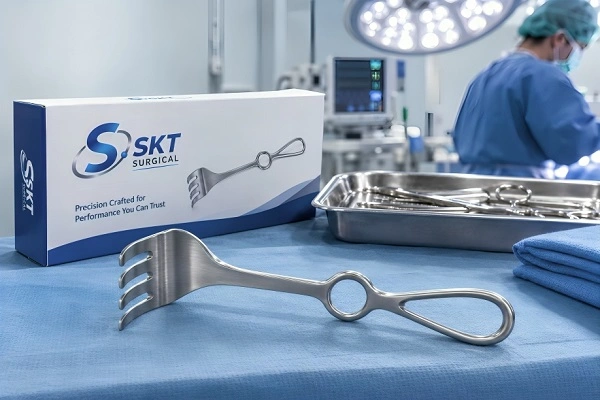
A surgeon reaches for the Ollier retractor the moment an incision needs to stay open without a struggle. This handheld instrument holds back thick tissue so the operating team can see the surgical site clearly and work with precision.
Surgeons rely on it most often in general and orthopedic procedures, where dense muscle and connective tissue can otherwise block the view.
If you’re a medical professional, a procurement manager, or simply someone curious about surgical hardware, this guide walks you through what the Ollier retractor actually does, how it’s built, and what to check before you buy one.
What Is an Ollier Retractor?
Picture a surgeon pulling back tissue with one steady hand while the other works inside the incision that’s the Ollier retractor at work.
It’s a simple hand-held tool with no locking mechanism, so someone on the surgical team holds it in place for as long as the retraction is needed.
The name traces back to Léopold Ollier, a 19th-century French surgeon widely credited as a founder of modern orthopedic surgery.
He’s well documented for pioneering new techniques and inventing surgical instruments though, like many surgical eponyms, exactly how this retractor came to carry his name isn’t formally recorded. The story is repeated across the industry more than it’s proven.
Design and Structure
The Ollier retractor follows a simple but effective build:
- Prongs: Most versions feature three or four blunt prongs at the working end. The blunt points minimize the possibility of ripping tissue during retraction.
- L-shaped hook: Many designs use an L-shaped or curved hook that conforms to the body’s natural contours, so it can pull back tissue without adding unnecessary pressure.
- Handle: The handle usually takes a teardrop or ring shape. A central ring lets the surgeon slide a finger through it, which improves grip and allows retraction from different angles.
- Blade width: The blade width varies per model, often from approximately 45 mm to 56 mm, so surgeons can choose an instrument proportional to the surgical field.
- Length: Standard lengths run roughly 8 to 9 inches, though variable-length versions exist for different procedures.
This combination of a blunt working end and an ergonomic handle keeps the instrument steady in the surgeon’s hand while limiting trauma to surrounding tissue.
Common Surgical Uses
Surgeons turn to the Ollier retractor in a range of settings, including:
- General surgery: It helps keep the intestines and other soft tissues in place during surgeries like appendectomies so the surgeon has a clear area to work in.
- Orthopedic surgery: Its prongs handle thicker, denser tissue, which makes it useful when exposing bone or joint structures.
- Confined surgical spaces: The slender profile lets it access narrow areas where bulkier retractors would not fit comfortably.
Across these uses, the goal stays the same: keep tissue out of the way without causing additional injury, so the surgical team can operate with full visibility.
Materials and Build Quality
Manufacturers typically forge the Ollier retractor from high-grade stainless steel, often sourced from Germany or the United States. That choice isn’t just about strength.
Steel of this grade resists corrosion through hundreds of autoclave cycles, so the instrument doesn’t pit, rust, or dull with routine use.
It also holds its shape under the physical stress of an operation, which matters when a surgeon needs consistent tension on tissue for an extended procedure.
Because of this durability, a single well-made retractor can serve a hospital for years rather than getting replaced after a handful of uses.
Buyers should still ask for the mill or material certificate before purchasing in bulk; it’s the paper trail that confirms the steel actually meets surgical-grade standards, particularly for instruments made under ISO 9001 manufacturing systems.
How to Choose the Right Ollier Retractor
If you’re sourcing this instrument for a hospital, clinic, or surgical set, keep a few practical points in mind:
Match the prong count to your procedure
Three-prong versions suit lighter retraction, while four-prong versions handle heavier tissue.
Check the blade width
When working on the abdomen, wider blades work best, while narrower blades work best in tighter orthopedic areas.
Confirm the steel grade
Ask the supplier for material certification, especially if you’re buying in bulk for a hospital sterile processing department.
Verify sterilization compatibility
Confirm the instrument is rated for your facility’s standard sterilization method, typically autoclaving.
Buy from a manufacturer with a track record
Established surgical instrument makers, including several based in Sialkot, Pakistan, and manufacturers in Germany and the United States, supply Ollier retractors that meet international quality benchmarks.
Comparing a few suppliers on material grade, finish quality, and after-sale support helps you avoid instruments that wear out or corrode early. SKT Surgical, for example, offers an Ollier Retractor built to these standards, and it’s worth reviewing as one option when you compare suppliers.
Final Thoughts
The Ollier retractor earns its place in the operating room through a straightforward design that does one job well: it holds tissue back safely so the surgical team can see and work without obstruction.
Whether you’re studying surgical instrumentation or sourcing tools for a clinical setting, understanding its prong configuration, blade width, and steel quality helps you pick an instrument that performs reliably case after case.
When you’re ready to buy, choose a supplier who can confirm material certification and sterilization compatibility, so the retractor you select holds up to the demands of daily surgical use.
You can view specifications and place an order for the Ollier Retractor at SKT Surgical directly on their product page.
FAQs
How is an Ollier retractor different from a self-retaining retractor?
A self-retaining retractor has a ratchet or frame that holds tissue open on its own, freeing up a pair of hands.
The Ollier retractor has no such mechanism; someone on the surgical team has to hold it throughout the procedure, which trades a bit of convenience for finer, more responsive control over the tissue.
Can the same Ollier retractor be used across different specialties?
To an extent. The four-prong version is common in general surgery for heavier tissue, while smaller or narrower blade variants suit orthopedic work in tighter spaces. Most surgical sets include more than one size for this reason.
How long does a stainless steel Ollier retractor typically last?
With proper sterilization and care, a well-made instrument can remain in clinical rotation for several years. Sharp edges dulling or handle deformation, rather than corrosion, are usually what eventually retires an instrument.