
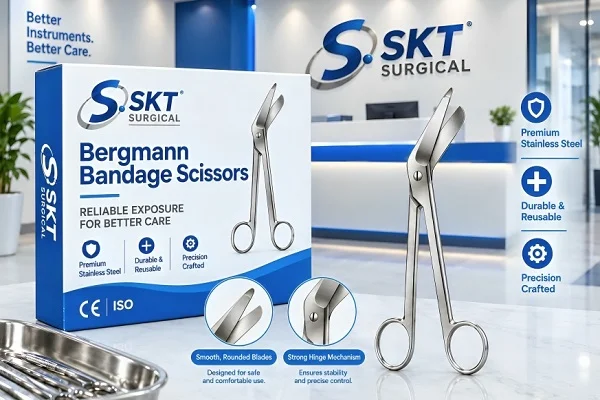
Bergmann Bandage Scissors are angled dressing scissors used to cut bandages, gauze, tape and padding quickly and safely.
Their angled blades and blunt tip let the user cut dressings close to the body while keeping the lower blade flat against the surface.
This is why they are a standard item in hospitals, clinics, emergency rooms and first aid kits.
Design Features
- Angled blades: The blades sweep out from the handles, keeping the cutting edge flat and in view, and preventing the hands from interfering with the patient.
- Blunt, rounded tip: One blade ends in a smooth tip that glides under the dressing without catching or digging into the skin.
- Broad upper blade with fine serration: The wider blade grips slippery gauze and bandage material instead of letting it slide away.
- Screw pivot: The center screw fitting keeps the blades aligned and also allows for adjustment or service.
- Long handles with round finger rings: The long shanks give leverage for cutting thick layers, and the large rings fit comfortably with or without gloves.
Common Sizes
Bergmann Bandage Scissors are usually available in these lengths:
- 14 cm (5.5″)
- 16 cm (6.3″)
- 18 cm (7″)
- 20 cm (8″)
- 23 cm (9″)
Shorter sizes suit first aid and small dressings. Longer sizes work better for thick bandages, plaster padding and heavy dressing layers. The 18 cm and 20 cm sizes are the most popular for general hospital use.
Material and Finish
Quality bandage scissors are made from instrument-grade stainless steel, chosen for strength, edge retention and corrosion resistance.
They are commonly offered with a satin (matte) finish, which reduces glare under bright lights and hides minor scratches.
Good instruments have smooth, burr-free edges and rings with no rough spots.
Where They Are Used
- Removing and changing wound dressings
- Cutting gauze, cotton padding and elastic bandages
- Cutting medical tape and adhesive dressings
- Emergency and trauma care
- Home nursing and first aid kits
- Ambulances, clinics, nursing stations and operating theatre dressing trolleys
What to Check Before You Buy
- Blade alignment: The blades should close smoothly and meet along the full cutting edge.
- Pivot movement: The joint should be smooth, not stiff and not loose.
- Tip safety: The blunt tip should be well rounded, with no sharp edges.
- Finish quality: There should be no rust spots, cracks or rough edges.
- Right size: Choose the length that matches the dressings you cut most often.
- Proper packing: Instruments should be clean and protected from scratches during shipping.
Cleaning and Care
- Rinse the scissors soon after use to stop blood and fluids from drying on them.
- Clean with a soft brush and a mild instrument detergent.
- Open the blades fully while cleaning to reach the pivot area.
- Dry thoroughly before storing, especially around the screw joint.
- Sterilize using the method suited to your facility’s routine.
- Inspect regularly for dull edges, looseness or corrosion.
- Do not use them to cut hard materials such as wire or plastic, as this damages the blades.
Get Product Details
Looking for bandage scissors for your hospital, clinic, distribution business or medical store? Visit our Bergmann Bandage Scissors product page to see available sizes, or send us your requirements to request a quote.
Quality documentation and product details are available on request. Contact us for samples, pricing and custom requirements.
Frequently Asked Questions
What are Bergmann Bandage Scissors used for?
They are used to cut bandages, gauze, padding and tape safely, especially close to the skin.
Why is one blade blunt?
The blunt tip slides under the dressing without injuring the patient, which makes cutting safer.
Which size should I choose?
Choose 14 to 16 cm for first aid and light dressings, and 18 to 23 cm for hospital use and thicker bandages.
Can they be reused?
Yes. Stainless steel scissors are designed for repeated use when cleaned and maintained properly.
Where can I order?
You can view the available sizes on our product page or contact us directly for pricing and availability.