
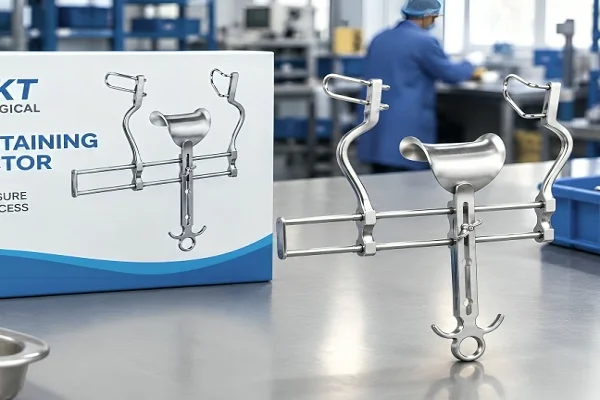
The Balfour retractor is a self-retaining abdominal retractor used in open abdominal and pelvic surgery.
Once positioned, it holds the edges of an incision apart on its own, so no assistant has to maintain tension by hand. It is commonly used in general, gynecologic, and urologic surgery.
This article explains how the instrument is built, what each part does, where it is used, how to care for it, and what to consider when buying one.
It is written for operating room professionals, procurement teams, and anyone researching the instrument.
Key Components
Lateral (Side) Blades
Two side blades sit against opposite edges of the incision. They are often open-framed (fenestrated), meaning the blade is a frame with open space rather than a solid plate.
The open design reduces the amount of solid material in the blade and provides visibility through the frame. Solid-blade versions also exist.
Frame and Crossbars
The blades are mounted on a frame of parallel bars, typically with a closed end on one side. The lateral blade holders are mounted on the parallel bars and can be positioned to achieve the required width.
A locking mechanism in each holder secures the chosen position.
Center Blade
A curved center blade attaches to the frame and may be used to provide retraction at the upper or lower end of the incision.
Some configurations are described as bladder blades when intended for pelvic exposure, though naming varies between manufacturers.
The blade is available in several sizes and may be supplied with the retractor or sold separately.
Blade Holder and Locking Screw
The center blade is carried on a slotted stem that slides along the frame. A thumb screw fixes it at the required height and depth. The stem usually ends in a ring or finger-grip shape for easier handling.
How It Is Used
After the incision is made, the team places the side blades inside the wound edges, spreads them to the width the surgeon needs, and locks them in position.
The center blade is then added if exposure at the end of the incision is required. Moist laparotomy pads are commonly placed between the blades and the tissue for protection.
Positioning and tension depend on the procedure, the patient’s anatomy, and the surgeon’s technique.
Common Surgical Applications
The Balfour retractor is suited to procedures that need sustained exposure of the abdominal or pelvic cavity:
- General abdominal surgery
- Open gynecologic procedures, such as hysterectomy
- Urologic and pelvic surgery
- Colorectal surgery
The final choice of retractor rests with the surgical team. Some procedures are better served by ring-based or table-mounted systems.
Sizes and Specifications
Balfour retractors come in a range of sizes, and specifications are not standardized across manufacturers. The following commonly differ:
- Maximum spread between the side blades (set by frame length)
- Side blade depth and width
- Center blade size
- Overall frame length
- Blade configuration, such as solid or fenestrated
- Smaller or pediatric versions
Because similar-looking instruments are not necessarily interchangeable, always confirm exact dimensions, and the compatibility of replacement parts, in the manufacturer’s product documentation.
Materials and Finish
Surgical retractors are typically made of stainless steel, which is chosen for its ability to withstand repeated cleaning and sterilization.
The steel grade, finish, and manufacturing process vary by maker, so request material details and quality certifications from the supplier.
Cleaning, Sterilization, and Maintenance
Follow the manufacturer’s instructions for use (IFU) and your facility’s protocols. In general:
- Point of use: Remove gross soil promptly and do not let instruments dry out before cleaning.
- Disassembly: Separate the center blade and holder so every surface can be reached.
- Cleaning: Use manual, ultrasonic, or washer-disinfector methods. Focus on sliding mechanisms, crossbar joints, and screw threads, where debris collects.
- Inspection: Check that parts slide smoothly, locks hold, and there is no corrosion, pitting, cracking, or bending.
- Lubrication: Apply an instrument-safe lubricant to moving parts if recommended.
- Sterilization: Use a method validated for the specific instrument and specified in the manufacturer’s IFU. Steam sterilization is used for many compatible stainless-steel surgical instruments, but parameters should not be assumed to be the same for every model.
- Storage: Keep in a dry, protected place and avoid stacking heavy items on the frame.
An instrument with a faulty lock or bent blade should be withdrawn from use until repaired or replaced.
Buying Considerations
- Intended procedures: Match blade size and configuration to the specialties that will use it.
- Set contents: Check whether the center blade is included and whether you need more than one size.
- Replacement-part availability: Confirm whether individual side blades, center blades, holders, screws, or other components can be ordered separately.
- Documentation: Ask for material information, quality management certification, and regulatory details relevant to your region.
- Reprocessing compatibility: Confirm the instrument suits your facility’s cleaning and sterilization methods.
- Handling: Weight and handling vary between models, so where possible, have clinical users assess them.
- Support: Ask about warranty and repair options.
As an example of the specifications that may be provided for a Balfour abdominal retractor, see the product listing for its stated dimensions and configuration.
Involve the surgeons and nurses who will use the instrument in the decision, since they are best placed to judge size and handling.
FAQs
Is “Balfour-type” the same as Balfour?
The terms are often used interchangeably. “Balfour-type” usually means a similar design from another manufacturer, so compare specifications directly.
Are there disposable versions?
Reusable stainless steel is the traditional format. Single-use alternatives exist in some markets, but availability and design vary.