
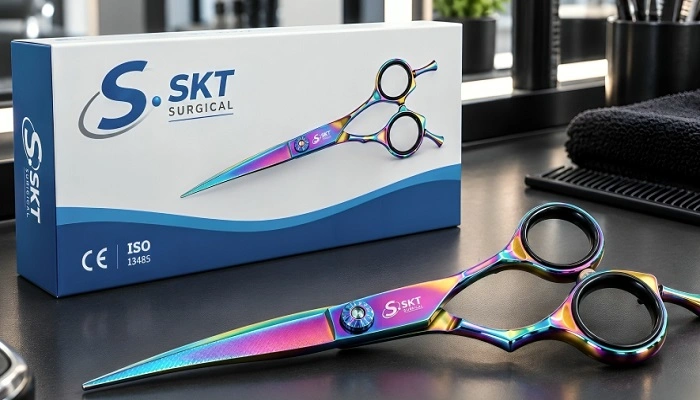
A 6-inch diamond-cut rainbow shear is built to give barbers and stylists a balance of control, reach, and everyday versatility — like this one.
But the colorful finish isn’t what actually determines whether a shear performs well; the steel, edge geometry, handle design, and tension system matter far more.
This guide covers what the 6.0 Diamond-Cut Rainbow Shear category actually is, how the size and finish affect real cutting work, and what to check before buying one.
What Is a 6.0 Diamond-Cut Rainbow Shear?
A 6.0 Diamond-Cut Rainbow Shear is a hairdressing scissor measuring 6.0 inches from tip to handle end, a size widely used for general haircutting, blending, and texturizing.
“Diamond-cut” refers to the blade’s edge finish, not a diamond material in the blade. It’s not a strictly standardized term across the industry, but it generally means the edge is ground and polished using diamond abrasives rather than a standard steel wheel, which can produce a finer, smoother edge with less resistance through hair.
The “rainbow” part comes from a titanium-based coating, often titanium nitride (TiN) applied via physical vapor deposition (PVD).
This gives the blade its iridescent, multi-colored look while adding hardness and corrosion resistance over the base steel. Coating chemistry can vary by manufacturer, so it’s worth checking a specific product’s listing rather than assuming TiN by default.
Why the 6-Inch Size Matters
Length changes how a shear feels in the hand and what it’s best suited for. Professional hair cutting shears generally range from about 5.0 to 7.0 inches, and a 6 inch barber shear lands right in the middle.
- 5.0 — 5.5 inches: better for close, detailed work short fades, tight texturizing, precision near the scalp.
- 6.0 inches: a middle-ground size that handles clipper-over-comb, scissor-over-comb fades, and everyday trims reasonably well.
- 6.5 — 7.0 inches: built more for volume, longer hair, bulk removal, less about fine detail.
That flexibility is a big reason the 6.0-inch size gets recommended so often to barbers who’d rather carry one dependable shear than switch tools mid-shift.
Key Features Worth Checking
Not every diamond-cut rainbow shear is built the same way, so a few things are worth looking at closely.
Blade steel is the starting point. Professional shears are made from a range of steels, Japanese steel (VG-10 and 440C stainless are common examples) and German steel both show up regularly and higher-grade steel generally holds its edge longer and chips less easily.
Edge type matters too, separately from the diamond-cut finish. Shears come with either convex or beveled edges; a convex edge shear is ground into a curved, razor-like shape and tends to produce cleaner cuts, while beveled edges show up more often on lower-cost shears.
Handle design is easy to overlook until your wrist starts complaining. Offset and crane handles are designed to promote a more natural hand position and can reduce strain for some users over a full day of cutting, though comfort also depends on hand size and individual technique.
A few other things to check: whether the tension screw holds adjustment without wobble over time, and whether the finger rest is removable or adjustable enough to suit different hand sizes.
Diamond-Cut vs. Standard-Cut Shears
| Factor | Diamond-Cut Edge | Standard-Ground Edge |
| Sharpening method | Diamond abrasive wheel | Conventional grinding wheel |
| Edge finish | Often very fine and low-friction | Quality varies with craftsmanship and steel |
| Cutting feel | Frequently described as a smoother glide | Can feel just as smooth when well-made and properly maintained |
| Typical price point | Often mid to high range, though this varies by brand | Spans entry-level to premium, depending on steel and build |
It’s worth being clear about one thing: a diamond-cut finish affects how smooth and fine the initial edge is, but it doesn’t by itself guarantee the edge will stay sharp longer.
Edge retention depends mainly on the steel’s quality, its heat treatment, the blade geometry, and how the shear is used day to day, not just the sharpening method.
A diamond-cut edge on mediocre steel won’t outlast a well-made standard edge on premium steel.
None of this makes a diamond-cut shear the automatic right answer for everyone. Someone cutting hair occasionally, or a student still building technique, may not notice the edge difference the way a full-time barber would and a well-maintained standard shear can still get the job done for lighter use.
Caring for the Shear
- Wiping the blades after every use of hair, product residue, and moisture left sitting on the blade will corrode it over time, coating or no coating.
- Oil the pivot area regularly so the blades keep moving smoothly instead of grinding metal on metal.
- Store it in its case when it’s not in your hand. Drops happen, and cases prevent the damage that follows.
- Skip cutting anything that isn’t hair. Paper, tags, synthetic fibers all of it dulls the edge faster than hair ever would.
On sharpening: send it to a professional rather than doing it at home. There’s no single fixed interval that applies to every shear; how often it needs sharpening depends on how much you use it, the steel quality, the edge geometry, and your cutting technique.
A shear used daily in a busy shop will need attention far sooner than one used occasionally, so it’s worth asking the manufacturer or a professional sharpener what interval makes sense for your specific shear and workload.
Who This Shear Fits
This shear tends to suit working barbers who want one versatile tool for fades, trims, and general scissor work day to day, along with cosmetology students putting together their first real kit.
It also appeals to stylists who like that their tool stands out on the chair without sacrificing performance, and to anyone stepping up from a basic beauty-supply shear.
It’s probably not the best fit if you specialize almost entirely in long-hair cutting or bulk removal; a longer shear, 6.5 inches or above, tends to serve that work better.
Buying Checklist
A few things worth confirming before you buy:
- Steel type and hardness rating industry sources commonly cite a range of roughly 55 to 63 HRC on the Rockwell scale for professional shears, with premium Japanese steel sometimes rated higher; treat this as a general guideline rather than a fixed standard, and check the manufacturer’s own spec where possible
- Whether the edge is genuinely diamond-cut and convex, or diamond-cut and beveled
- Whether the finish is a genuine PVD titanium coating (commonly titanium nitride, though exact chemistry varies by brand) rather than a painted or anodized surface, since that affects how long it actually lasts
- Warranty terms, and whether the seller offers sharpening or adjustment support
- Return policy a shear really needs to feel right in your hand, and that’s hard to judge from a photo
Product-Specific Details
This guide covers the 6.0 Diamond-Cut Rainbow Shear as a product category, the size, edge finish, and coating type that define it.
It doesn’t substitute for the exact specifications of a particular shear you’re considering: the precise steel grade, weight, tension system, country of manufacture, and warranty terms differ from one manufacturer to the next.
Always check the specific product listing for those details before buying.