
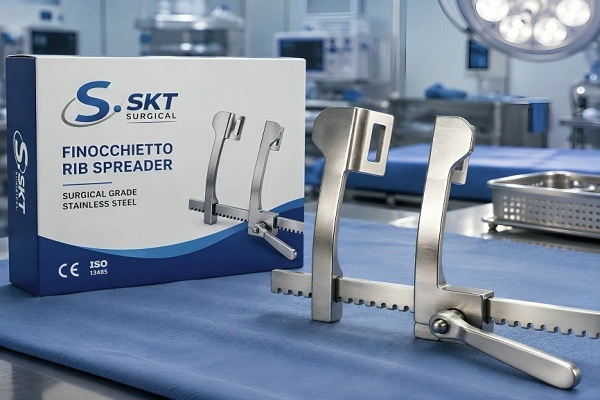
The Finochietto rib spreader is the go-to instrument for holding the ribs apart during open chest surgery.
Because it’s ratcheted, it locks in place by itself, so no one on the surgery team has to hold the retractor by hand. Here’s what it does, how it works, and what to check before buying one.
What Is a Finochietto Rib Spreader?
A Finochietto rib spreader is a retractor used to hold the ribs apart during open chest procedures. It’s also called a Finochietto retractor or thoracic rib spreader.
It belongs to the broader category of chest retractors used in thoracic surgery.
Hand-held retractors need an assistant to apply continuous force. This instrument doesn’t.
Once the ribs have been separated to the desired width, it locks into place on its own, which frees the surgical team to focus on the procedure instead of holding exposure the whole time.
Main Components
Arms
The two curved arms form the main body of the instrument. One typically stays fixed while the other moves outward to create the spreading action.
Blades
These are the curved ends that make direct contact with the ribs, shaped to distribute pressure across bone and tissue. They often include fenestrations to improve grip while limiting trauma.
Ratchet mechanism
This is the core of the design. As the arms separate, the ratchet holds the instrument at each incremental stage so it can’t close back on its own.
Handle
Sometimes crank-operated. It lets the surgeon or assistant control the rate and degree of separation.
Locking system
Works alongside the ratchet to secure the chosen opening width, and can be released in a controlled manner once retraction is no longer needed.
Frame
Connects all the components. It’s built to withstand repeated use, sterilization cycles, and the mechanical stress of spreading the rib cage.
How Does It Work?
The working principle is straightforward, though it calls for careful technique in the operating room.
- After the thoracotomy incision is made and the intercostal muscles are divided, the closed blades are positioned between two ribs.
- The surgeon or assistant operates the handle, driving the ratchet and gradually widening the arms.
- As the arms move apart, the ratchet engages at each stage and stays in place without any extra work from the user.
- Separation continues in gradual increments until the exposure needed for the procedure is achieved.
- Once the procedure is complete, the lock is released in a controlled fashion and the ribs return toward their natural position.
This staged, hands-free approach is what sets the Finochietto-style spreader apart from simpler hand-held retractors. It’s a big reason the design has remained a standard for so long.
Common Surgical Applications
- Thoracotomy. The primary retractor used for gaining access after the incision.
- Cardiothoracic surgery. Provides the necessary exposure for treatments on the heart and major vessels.
- Lung surgery. Lobectomy, pneumonectomy, and similar procedures depend on adequate rib separation.
- Chest trauma. Rapid, reliable separation is essential in emergency thoracotomy or trauma exploration.
- Esophageal surgery. Some chest-based approaches also rely on this retractor.
- Other open chest procedures. Any operation requiring sustained access to the chest cavity.
Key Features
- Holds rib separation without continuous manual effort
- Adjustable opening controlled through the ratchet and lock
- Different diameters of blades for different anatomies and types of incision
- Reusable and built for repeated procedures
- Made from surgical-grade stainless steel
- Works with steam autoclave sterilization
- Corrosion resistant, thus it can be reprocessed again over its useful life
Available Sizes
Finochietto rib spreaders come in a range of sizes, generally differentiated by blade length and maximum arm spread.
Pediatric and adult versions are the main distinction, with adult sizes varying further to suit different body types.
Surgeons choose a size based on the patient’s chest wall dimensions and the procedure at hand. Smaller blades are typically required for pediatric patients and narrower incisions.
Broader exposure needs to push toward larger ones. Facilities running a wide mix of thoracic procedures often stock several sizes to cover this range.
Material and Manufacturing
Most Finochietto rib spreaders sold for clinical use are made from surgical-grade stainless steel, chosen for its strength, corrosion resistance, and compatibility with repeated sterilization.
Worth noting: claims about a specific alloy or country of origin should only be made when verified for the individual manufacturer, since sourcing varies between suppliers.
A satin finish is commonly applied to cut glare under operating room lighting while keeping a clean look.
Reputable manufacturers pair precision manufacturing with quality inspection, checking dimensional accuracy, ratchet function, and blade alignment before release.
These are reusable instruments, so manufacturing quality has a direct bearing on how many sterilization cycles and procedures they can reliably support over their working life.
Cleaning and Sterilization
Pre-cleaning
The instrument should be cleaned right after use, before blood and tissue debris dry, following the facility’s standard decontamination protocol. Manual or automated washing needs to reach the ratchet and hinge areas, where debris tends to accumulate.
Inspection
Before sterilization, check for bent blades, worn ratchet teeth, or compromised locking function. Anything that doesn’t move smoothly or lock securely should be set aside for repair or replacement.
Lubrication
Where the manufacturer’s instructions call for it, instrument-grade lubricant can be applied to the ratchet and hinge to keep motion smooth between uses.
Steam autoclave sterilization
Once cleaned and inspected, the instrument is typically sterilized by steam autoclave. Facilities should follow the temperature, pressure, and cycle time specified in the manufacturer’s instructions rather than working off generic assumptions, since parameters differ between products.
Advantages
- Frees the team from continuous manual retraction
- Graduated, controlled separation through the ratchet system
- Different sizes for different patients and operations
- Durable, reusable construction suited to repeated sterilization
- Widely recognized and compatible with standard thoracic instrument trays
- Long service life when properly maintained
Limitations
The instrument applies mechanical force to separate the ribs, so technique matters. Opening it too quickly, or beyond what the anatomy allows, can place added stress on the ribs and surrounding tissue. Surgeons account for this as part of normal operative technique. It’s not treated as a flaw in the design.
Performance also depends on upkeep. A spreader with worn ratchet teeth or damaged blades won’t hold position reliably. That’s why routine inspection between uses is standard practice, not an optional step.
Buying Considerations
- Material quality. Confirm surgical-grade stainless steel suited to repeated sterilization.
- Manufacturing standards. Check that the manufacturer follows documented quality inspection processes.
- Blade size range. Match sizes to the facility’s typical patients and procedure mix.
- Finish. Satin or other coatings can help cut down on glare and make instruments easier to see.
- Sterilization compatibility. Confirm validation for steam autoclave use.
- Warranty. Review any warranty or service terms the supplier offers.
- Supplier reputation. Track record, documentation practices, and support for reprocessing guidance.
It’s generally worth requesting documentation directly from the manufacturer rather than relying on general assumptions, particularly around material certification and sterilization validation.
You should also review the product specifications to ensure the Finochietto Rib Spreader matches your facility’s clinical and sterilization requirements.
Maintenance Tips
- Maintain the instrument so that the blades and the locking mechanism are protected from impact damage
- Rotate instruments within a set to spread wear evenly across the inventory
- As part of your regular tracking, keep track of the times you sterilize and check things