
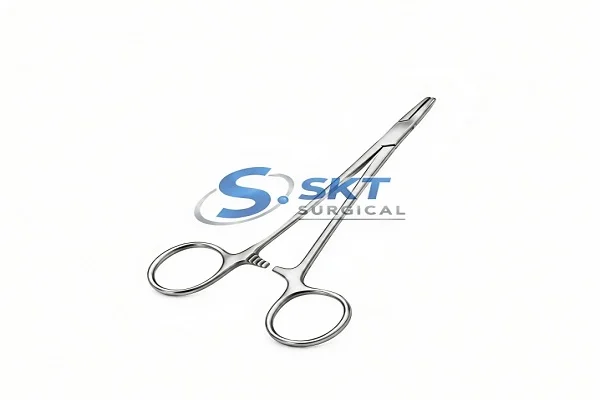
A needle holder (also called a needle driver) is one of the most commonly used instruments in surgery. It grabs the suture needle securely and enables the surgeon to guide it through tissue with control and precision.
Main Parts of a Needle Holder
- Jaws: The needle is held between two specially shaped ends of the instrument. Small grooves or a fine cross-pattern on these surfaces help prevent unwanted movement during suturing.
- Shanks: The long sections between the box lock and the handles. Their length affects reach and control.
- Box lock (joint): The joint that connects the two halves and allows smooth jaw movement.
- Ratchet: The locking mechanism on the handles. It keeps the jaws closed on the needle without the user having to keep squeezing.
- Finger rings: Where the thumb and ring finger sit, allowing steady, controlled movement.
Types of Needle Holders
Mayo-Hegar
A widely used general-purpose design. It has short, strong jaws, ring handles and a ratchet lock, and it suits many routine suturing tasks. It is available in several lengths.
Olsen-Hegar
This design has suture-cutting scissors built into the jaws, so the user can hold the needle and cut the suture without changing instruments.
It is convenient, but it is not ideal for every task. The integrated scissors are designed to cut suture material, not the needle. Choose a suitable model for the needle and suture being used.
Webster
This needle holder features a compact, lightweight design suited to fine suturing tasks. Its dimensions and jaw design should be appropriate for the needle being used.
Castroviejo
A spring-handle design (no finger rings) made for very fine, precise work, mainly in ophthalmic and microsurgery.
Specialized Needle Holders
Vascular, cardiovascular and microsurgical procedures often call for specialized holders with particular jaw shapes, lengths and handle styles.
Adson needle holders are another design found in surgical instrument catalogues. See the Adson needle holder specifications for product information.
Stainless Steel vs. Tungsten Carbide (TC)
Most needle holders are made from medical-grade stainless steel, which offers strength and corrosion resistance when properly maintained.
Some models have tungsten carbide (TC) inserts in the jaws. Tungsten carbide is a very hard material that can provide durable gripping surfaces and good wear resistance.
Many TC holders have gold-coloured handles, and some carry a “TC” marking, but colour alone is not proof of material, so always check the manufacturer’s product information.
Quick comparison
| Feature | Stainless steel jaws | Tungsten carbide inserts |
| Grip on needle | Depends on jaw design and condition | Designed to provide durable gripping surfaces |
| Wear resistance | Depends on material quality and use | Generally high at carbide gripping surfaces |
| Price | Often lower | Often higher |
| Best for | General use, depending on the model | Frequent use or situations where carbide inserts are preferred |
Which Size Should You Choose?
Size is determined by the surgery, the needle, the shape of the instrument, and how deep the surgical site is. The following lengths are general guidance rather than fixed rules:
- Shorter holders (around 12 to 15 cm): May be suitable for smaller or more accessible surgical sites, depending on the needle and holder design.
- Medium holders (around 18 cm): May be suitable for many general suturing tasks.
- Longer holders (20 cm and above): Maybe helpful for harder-to-reach surgical sites that are deeper.
Exact lengths and intended uses vary by manufacturer and model, so check the manufacturer’s specifications before selecting an instrument.
The holder should also be appropriate for the needle: an unsuitable jaw design or grip may allow the needle to slip or rotate, while excessive gripping force can damage a delicate needle.
Buying Guide: What to Check
- Jaw alignment: The tips of the jaws should touch evenly, without gaps or crossing.
- Ratchet grip: It should lock firmly and release smoothly, without sticking or slipping.
- Box lock smoothness: The joint should open and close freely with no wobble or rough spots.
- Jaw surface: Serrations should be clean and even.
- Finish and material: Look for good-quality stainless steel with a clean finish and no rough edges.
- Size for your use: Match length and jaw type to the needles and procedures you work with.
Cleaning, Sterilization and Care
Reusable needle holders must be processed correctly before every use:
- Rinse or clean the instrument soon after use so blood and tissue do not dry on it.
- Clean with compatible agents and approved equipment, following the manufacturer’s instructions.
- Open the ratchet and clean carefully around the box lock and jaw serrations, where debris collects.
- Inspect for corrosion, damaged or misaligned jaws, a loose joint or a faulty ratchet. Remove damaged instruments from use.
- Sterilize using a validated process. Steam sterilization (autoclave) is common for compatible instruments, but always follow the manufacturer’s processing instructions.
- Dry and store properly to prevent corrosion.
Regular inspection and care extend the life of the instrument and support patient safety.