
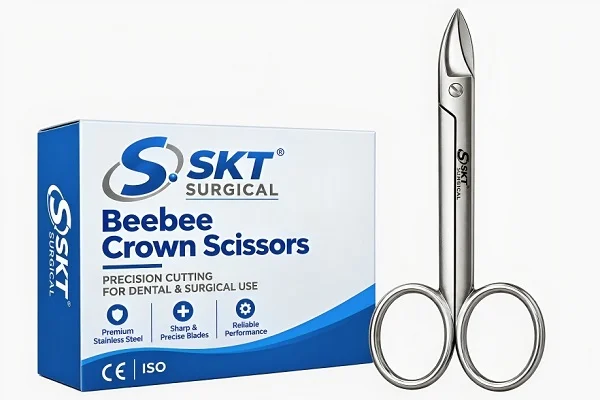
Working with temporary crowns and thin metal bands needs an instrument that cuts cleanly and stays under control.
Beebee Scissors, also called Beebee Crown Scissors or crown and collar scissors, are a dental instrument built for this kind of work.
They are made of stainless steel. They are available in straight and curved styles with plain or serrated blades.
What Are Beebee Scissors?
Beebee Scissors are a type of crown scissors in the dental instruments category. They have finger rings, a pivot joint secured by a screw, and short, sturdy blades built to cut heavier material.
Depending on the model, the blades are sharp with a pointed tip, or one blade has a serrated (toothed) edge. The serrations help grip the material and reduce slipping while cutting.
Available Models
Beebee Scissors are available in several variations:
- Straight Beebee Crown Scissors: straight blades with a sharp, pointed tip
- Curved Beebee Crown Scissors: curved blades for a different angle of work
- Straight One-Edge Toothed Scissors: One of the blades has a sharpened edge
- Curved One-Edge Toothed Scissors: curved blades with one serrated edge
Sizes
These scissors are available in 10 cm, 10.5 cm and 12 cm lengths. Available sizes can differ between models, so the exact sizes for each model are listed on the Beebee Crown Scissors product page.
Features
- Stainless steel construction: durable and suitable for repeated sterilization
- Short, sturdy blades: made for heavier materials such as temporary crowns
- Ring handles: finger rings for holding and controlling the instrument
- Straight or curved design: a curved model can give controlled access to the crown material
- Plain or serrated blades: a serrated edge improves grip on the material
- Screw joint: connects the two blades
Main Applications
Beebee Scissors are used in dental crown-related work, such as trimming and contouring temporary crowns and cutting thin metal bands or strips.
The exact use depends on the model and the clinician’s technique. These are dental instruments intended for use by trained professionals.
Straight or Curved: Which Should You Choose?
A straight model cuts along a direct line, while a curved model can give better access to the crown material in certain positions.
If the material tends to slip during cutting, a one-edge serrated model gives a firmer grip. Your own method and the way you do things are the most important, so pick wisely.
Cleaning and Sterilization
Beebee scissors are used more than once, so they need to be cleaned and germ-free before each use. In general:
- Rinse off debris as soon as possible after use.
- Clean with a suitable instrument detergent or an ultrasonic cleaner.
- Dry the instrument completely.
- Sterilize it according to the manufacturer’s instructions, for example by steam sterilization (autoclave).
- Store it in a clean, dry place.
Always follow the instructions for your specific model, because recommendations can vary. Avoid harsh chemicals or abrasive tools that could damage the blades or the finish.
Care Tips
- Do not use the scissors on materials they are not designed to cut.
- Inspect the blades and the screw joint regularly.
- Keep them separate from heavy instruments to protect the blade edges.
- Replace or have the instrument professionally serviced if it becomes dull or loose.
Final Thoughts
Beebee Crown Scissors are a practical stainless steel instrument for dental clinics and labs. With straight, curved and serrated options, you can match the model to the work you do.
Check the model and blade type against the product specifications before choosing.
Frequently Asked Questions
Can one pair of Beebee Scissors be used for every crown material?
Not necessarily. Different models are made for different materials, so check the manufacturer’s instructions for what your specific model is designed to cut.
Which model is better if the material keeps slipping?
A one-edge serrated model is the better choice, because the toothed edge holds the material more firmly while you cut.
Do I need to sterilize new scissors before the first use?
Yes, it is good practice to clean and sterilize any reusable instrument before its first use, following the manufacturer’s instructions.