
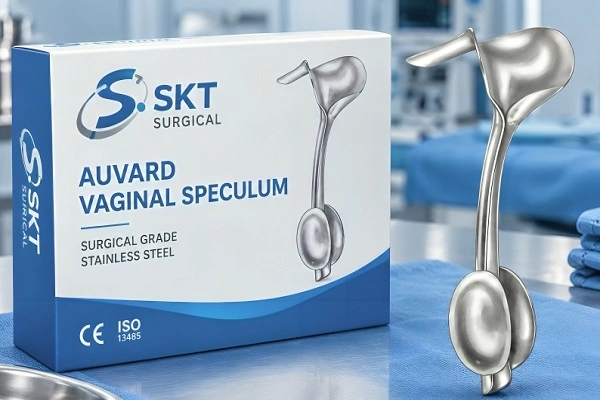
Auvard vaginal specula are weighted surgical instruments that gynecologists use to keep the vaginal canal open during procedures, without requiring an assistant to hold anything in place.
A routine pelvic exam typically uses a handheld speculum. This instrument is different: it sits inside the vagina under its own weight, leaving the surgeon’s hands free to operate.
Professionals in obstetrics and gynecology, sterile processing, and surgical instrument procurement benefit from understanding how this device is built and how it compares to other retractors.
What Is an Auvard Vaginal Speculum?
An Auvard speculum is a single-blade, weighted retractor designed to hold back the posterior wall of the vagina during surgery.
A Graves or Cusco speculum opens like a beak, using two hinged blades. The Auvard works differently: a single long, curved blade, bent at an angle, attaches to a handle that carries a heavy spherical weight.
Once the blade is positioned against the posterior vaginal wall, gravity pulls the handle downward and outward.
This braces the blade in place and displaces the posterior wall, opening a clear view of the cervix and upper vaginal canal without requiring anyone to hold the instrument which is why it is classified as a self-retaining speculum.
How an Auvard Speculum Is Built
Every Auvard speculum shares the same basic anatomy, though exact dimensions vary by manufacturer:
- A single curved blade half-tube shaped, bent at a fixed angle (commonly 45°, 75°, or 90°) from the handle.
- A weighted sphere on the handle, sized to hold the blade in position under its own weight.
- A handle long enough to remain outside the body while the blade rests against the posterior vaginal wall.
Blade dimensions differ by manufacturer and intended use, generally in the range of roughly 3 to 4 inches long and 1.5 to 2 inches wide, with extra-long and extra-wide versions available for deeper retraction or a wider field of view.
Most current instruments are machined from surgical-grade stainless steel, chosen for its durability under repeated sterilization and resistance to corrosion.
The mechanism itself has few points of failure: there is no screw, hinge lock, or ratchet, which is one reason the basic design has changed relatively little since the 19th century.
What It’s Used For
Surgeons use an Auvard speculum when a procedure requires sustained, hands-free exposure of the vaginal canal and cervix. The most common applications include:
- Vaginal hysterectomy — retracting the posterior wall so the surgeon can work at the vaginal apex and cervix without an assistant holding a retractor.
- Pelvic organ prolapse repair — providing steady exposure during procedures such as posterior colporrhaphy.
- Other vaginal procedures, including certain cervical and hysteroscopic cases requiring a stable field of view.
Because the weight sustains the retraction, this instrument is particularly useful in longer procedures, where a hand-held retractor could tire an assistant or shift position over time.
Auvard vs. Other Vaginal Specula
| Speculum type | Design | Typical use |
| Auvard (weighted) | Single blade, weighted, self-retaining | Surgical procedures needing hands-free retraction |
| Graves | Two hinged blades, handheld or self-retaining with a screw | Routine pelvic exams, Pap smears |
| Cusco (bivalve) | Two blades that open with a screw mechanism | Office exams, colposcopy |
| Sims | Single curved blade, handheld | Lateral wall retraction, postpartum exams |
Sizes and Weight Options
Manufacturers commonly list Auvard specula in the following configurations, based on published surgical instrument catalogs:
- Weight: 2.0 lb, 2.5 lb, and 3.0 lb are the most commonly stocked options.
- Blade angle: typically 45°, 75°, or 90° from the handle.
- Blade size: ranging from shorter, narrower blades around 1.5″ x 3.25″ up to extra-long blades exceeding 4″ for deeper retraction.
Exact weights, angles, and dimensions can vary between manufacturers, so it’s worth checking a specific supplier’s catalog for precise specifications before ordering.
Which combination to use depends on the patient’s anatomy, the depth of the vaginal canal, and the procedure being performed, a decision made by the operating surgeon.
Care, Cleaning, and Sterilization
As a reusable stainless-steel instrument, an Auvard speculum follows standard hospital reprocessing steps:
- Point-of-use cleaning immediately after the procedure, before blood or tissue can dry on the surface.
- Manual or automated cleaning, following the facility’s validated cleaning procedure.
- Inspection for pitting, corrosion, or damage at the weight-to-handle joint.
- Steam sterilization (autoclaving), the standard method for instruments of this type.
Blade coatings and joint construction vary between brands, so facilities should follow the specific manufacturer’s instructions for use, along with their own sterile processing department’s validated protocols, rather than a generic cleaning routine.
Few Limitations
Because the retraction relies on gravity, correct patient positioning typically lithotomy is necessary for the speculum to sit properly.
The instrument also retracts only the posterior wall; anterior or lateral exposure requires a separate retractor, such as a Deaver or right-angle retractor.
Selecting a heavier or longer blade than a given patient requires can cause discomfort, particularly for patients with a shorter vaginal canal, which makes appropriate sizing an important consideration.
Buyer’s Guide: Before You Buy, What to Look For
Sourcing Auvard specula for a hospital, clinic, or distributor inventory generally involves checking the following:
Certification
Regulatory status varies by product and by market a device cleared for sale in one country isn’t automatically cleared everywhere.
Ask the supplier to confirm the specific certifications that apply to the exact product and region you’re buying for, such as FDA clearance in the US, a CE mark in the EU, or manufacture under ISO 13485, and request documentation rather than taking claims on a product page at face value.
Material specification
Ask the supplier which steel grade the instrument is made from and request documentation rather than relying on general marketing terms.
Surgical-grade stainless steel from established manufacturing regions is common in this instrument category, but material quality should be confirmed per product, not assumed from country of origin alone.
Finish and construction
A consistent mirror or satin finish, with no visible tool marks at the blade edge or the weight-to-handle joint, is a reasonable indicator of manufacturing quality; that joint is typically the first point of failure on a poorly made instrument.
Weight and blade match
Match the weight and blade length to the procedures performed most often, using the sizing information above as a starting point, and confirm exact specifications with the supplier before ordering.
After-sales support
Warranty coverage, availability of replacement parts, and responsive customer service are worth factoring into a purchasing decision alongside price.
For hospitals and clinics ordering in volume, it’s also worth discussing bulk pricing and lead times directly with a supplier, since surgical inventory needs tend to be recurring rather than one-off.